
Introduction
Every engineer reaches this fork in the road. On one side, the KRK Rokit: yellow cone, hyped low end, built-in DSP, and a reputation for making everything sound good. On the other side, the Yamaha HS Series: white woofer, brutally flat response, and a direct lineage to the NS-10s that defined generations of professional mixing. You want monitors that make your tracks translate. But do you want monitors that flatter your source material, or ones that punish you until you get it right?
The Rokit line has long been the favorite of bedroom producers and beatmakers who prioritize immediate satisfaction and a fun listening experience. The HS series is the tool of engineers who sweat over a snare drum’s phase coherence for an hour. Neither is wrong. But one is likely wrong for your specific workflow. This is a head-to-head breakdown of the sonic signatures, build philosophies, and practical tradeoffs of these two studio monitor titans.
KRK Rokit vs Yamaha HS: Quick Verdict
For mixing and mastering that demands translation across every playback system: Choose the Yamaha HS series. Its flat response reveals flaws you didn’t know existed — and that is the point.
For beatmaking, production, and workflow where vibe matters: Choose the KRK Rokit. The boosted low end and built-in room EQ make the creative process more immediate and enjoyable.
For home studios in untreated or small rooms: The KRK Rokit wins. The front-firing bass port reduces boundary coupling issues, and the built-in DSP lets you dial in compensation without external gear.
For engineers who already have acoustic treatment and trust their listening environment: The Yamaha HS is the better investment. It will show you exactly what your room is doing — for better or worse.
KRK Rokit Overview
KRK Systems launched the original Rokit in the early 2000s, and the line quickly became synonymous with affordable, bass-forward monitoring. The “Rokit” name itself is a nod to the brand’s flagship Exposé monitors — the ones that were big, expensive, and out of reach for most home studio operators. The Rokit democratized that sound.
The current generation, the Rokit G4, features a Kevlar-woven woofer that KRK claims reduces cone breakup and delivers more consistent bass response across the frequency range. The waveguide design has been updated to improve off-axis response, though the signature character remains: a measured low-end bump that makes kick drums and 808s feel punchy and present. The iconic yellow cone is as much a branding statement as a functional design choice — it is dyed, not painted, so it won’t flake over time.
Every G4 monitor includes built-in DSP with selectable EQ modes (Mix, Create, Focus) that adjust the frequency curve for different tasks. This is a genuine utility, not marketing fluff. You get physical controls on the back for HF trim and LF adjustment, plus an optional auto-standby feature that saves power if you forget to turn them off. The result is a monitor that tries to meet you halfway — it is forgiving, flexible, and engineered to sound good in imperfect spaces.

Yamaha HS Series Overview
If Rokit represents the “make it sound good” school of monitoring, Yamaha’s HS series represents the “show me the truth” school. This line is a direct descendant of the legendary NS-10 monitors, which became an industry standard in the 1980s and 90s not because they sounded great, but because they were unforgiving. Engineers learned that if a mix sounded balanced on NS-10s, it would translate to almost anything.
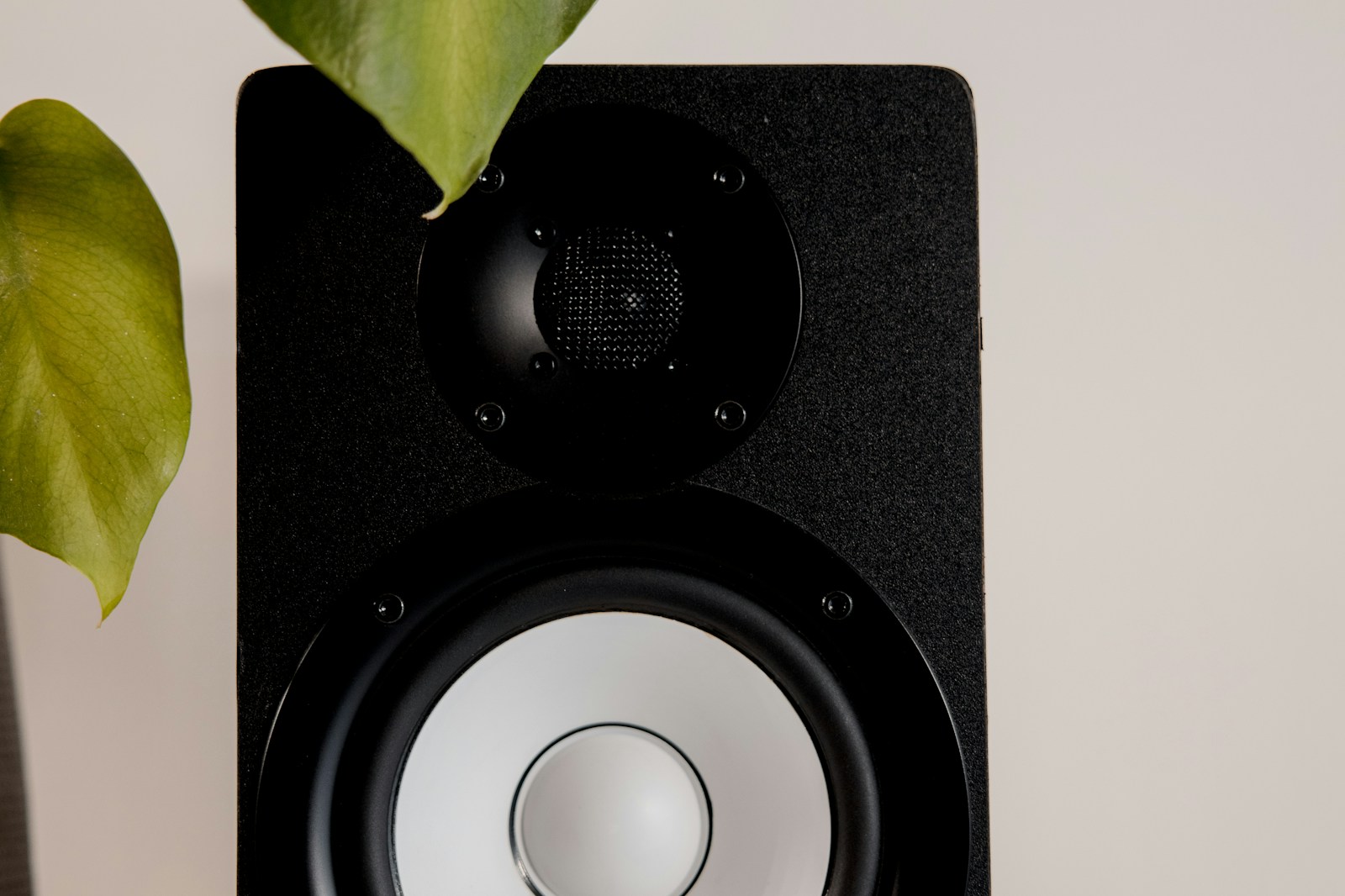
The HS series carries that DNA forward. The white woofer is not just cosmetic — it is made from a proprietary cellulose and wood fiber blend that Yamaha says provides a stiffer, more responsive cone surface with less coloration. The waveguides on the tweeter are designed to match the NS-10’s famous directivity, which forces you to sit in a narrow sweet spot but delivers incredible imaging once you do.
The most important feature of the HS series is its deliberately flat frequency response. Yamaha did not engineer any hype into these. The low end rolls off naturally, the midrange is present without being forward, and the highs can be perceived as harsh by listeners accustomed to softer high-frequency roll-offs. That harshness is the point: it tells you when your sibilance is out of control faster than any other monitor in this price bracket.
The lineup includes the HS5, HS7, and HS8, with the number roughly correlating to the woofer size in inches. The HS8 is the most extended version, offering deeper bass response and higher SPL capability. All models share the same design philosophy, so your choice is driven by room size and how much low-end extension you need.
Sound Quality: Frequency Response & Imaging
This is where the KRK vs Yamaha difference becomes stark.
The KRK Rokit G4 series has a frequency response that is not flat. Measurements from independent sources (including SoundOnSound and various measurement forums) show a roughly 2–3 dB bump in the low end, starting around 100 Hz and peaking near 60 Hz. That bump makes kick drums feel bigger and bass lines more present. It also means that if you mix on Rokits, your low end will often sound weak when played back on flat systems like car stereos or headphones. You have to learn the bump and mentally compensate.
The Yamaha HS series, by contrast, aims for a response that is within ±2 dB from about 60 Hz to 20 kHz. The low end does not extend as deep as the Rokit with the same woofer size — the HS8 reaches down to about 38 Hz at -10 dB, while the Rokit 8 G4 claims 36 Hz at -10 dB with a more gradual rolloff. But the HS’s low end is more consistent, with less distortion at moderate levels.
Imaging is another area of divergence. The HS series offers a more defined stereo image, but only if you are sitting in a very specific listening position. Move your head six inches off-center, and the image collapses faster than on the Rokits. The Rokit’s waveguide design gives a wider, more forgiving sweet spot — ideal for collaborative sessions or if you tend to move around while producing. You sacrifice some pinpoint accuracy for usability.
For hip-hop, EDM, and bass-heavy genres: The Rokit’s low-end bump can actually be an advantage. You hear the sub-bass content more clearly without needing a subwoofer, which helps with arrangement decisions.
For acoustic, classical, jazz, and vocal-focused mixing: The Yamaha HS is the cleaner choice. You hear the true tonal balance of the source material without the monitor adding its own emphasis.
Build Quality & Design
Both monitors feel sturdy for their price point, but they take different approaches.
The KRK Rokit G4 uses a front-firing bass port. This is a significant practical advantage if your monitors are placed close to a wall. Rear-ported speakers get muddy when pushed against a boundary because the reflected air from the port cancels out or shifts the low-end response. A front port eliminates that variable. If your desk is flush against a wall and you cannot pull the monitors forward, the Rokit is the safer choice.
The Yamaha HS series uses a rear port. Yamaha’s engineers tuned the resonance suppression using what they call “white absorbers” — small foam panels inside the cabinet that reduce standing waves. The cabinet itself is made from MDF with internal bracing to reduce vibration. It is a high-quality build that reduces coloration from the cabinet itself. But rear porting means you need at least 6–8 inches of clearance behind the monitor for proper airflow. In tight spaces, this matters.
Power handling is similar across equivalent sizes. The Rokit 8 G4 delivers 145 watts total (80W to the woofer, 65W to the tweeter). The HS8 delivers 120 watts total (75W + 45W). Neither will fill a large room, but both are sufficient for nearfield monitoring at moderate to high levels.
The Rokit has an edge in power distribution — more wattage to the woofer gives it slightly better headroom on low-end transients without distortion. The Yamaha feels more controlled across the entire frequency range, but clips earlier on sudden bass hits.
Connectivity & Controls
Input options are standard for both: XLR and TRS balanced connections. The Rokit G4 adds a third input option — RCA unbalanced — which is useful for connecting consumer-level gear like a phone or a DJ controller without a DI box. Yamaha keeps it pure: XLR and TRS only.
The control panels reveal different philosophies. The Rokit G4 has a rotary volume knob on the front (bright yellow, naturally) and physical switches on the back for HF trim (±2 dB), LF cut (various frequencies), and the three EQ modes: Mix, Create, and Focus. Mix mode is the flattest of the three (though still with the low-end bump), Create boosts the lows and highs slightly for a more “fun” listening experience, and Focus tightens the stereo image while narrowing the frequency range.
The Yamaha HS series keeps controls minimal but precise. On the back, you get dip switches for ROOM CONTROL (high-frequency roll-off to compensate for reflective rooms) and HIGH TRIM (attenuation at very high frequencies). These are physical switches, not software-controlled. The front has a power switch and a volume knob. That’s it. No presets, no auto-standby, no DSP modes. You are expected to know what you want and set it once.
Practical difference: If you switch between mixing for fun and critical listening, the Rokit’s front-panel control is more convenient. If you set up your system once and never change it, the Yamaha’s simpler layout is fine.
Room Correction & DSP
This is perhaps the biggest philosophical divide between the two lines.
The KRK Rokit G4 includes built-in DSP that gives you software-adjustable EQ curves. There is no associated desktop software that ties you to a laptop — the DSP settings are stored on the monitor itself and selected via physical switches. This is a practical choice for people who work in less-than-ideal rooms. You can cut the low end at 80 Hz if you know your room has a 50 Hz buildup, or trim the highs if your space is too reflective. It is not as powerful as a full room correction system like Sonarworks, but it is built into the price of the monitors.
The Yamaha HS series has no DSP. The only adjustments are the dip switches on the back, which offer bass roll-off at three frequencies (or off) and a high-frequency shelf. Yamaha trusts that you will either treat your room properly or use an external correction system. This is the more “pro” approach in some circles — keep the signal path as clean as possible, and fix the room separately. It also means you cannot fix a peaky mode with the monitor itself; you need acoustic panels or digital correction upstream.
Which saves time and money? If your room is untreated and you are not ready to invest in acoustic panels, the Rokit’s built-in DSP gives you tools to compensate for bad placement and poor acoustics without spending extra. If you already have a treated room with bass traps and diffusion, the Yamaha’s clean analog path is preferable because you are not adding another layer of processing.
Which One Should You Buy?
Buy the KRK Rokit G4 if:
- You produce bass-heavy genres (hip-hop, EDM, trap, pop)
- Your room is small, untreated, or forces monitors against a wall
- You want a forgiving listening experience that makes you feel good during sessions
- You value built-in room compensation without extra gear or software
- You collaborate with others and need a wider sweet spot
Buy the Yamaha HS series if:
- You do critical mixing and mastering for clients or your own catalog
- Your room is acoustically treated or you use digital room correction (Sonarworks, etc.)
- You need mix translation that is trusted across professional studios
- You hate the idea of a monitor adding its own flavor to your source material
- You work with acoustic instruments, vocals, or material where tonal accuracy matters most
Scenario breakdown:
- Bedroom producer making beats for streaming: KRK Rokit. The low-end presence helps you feel the groove, and the DSP helps you survive a bad room.
- Mix engineer charging for sessions: Yamaha HS. Your clients expect translation. They will hear if your mix is colored.
- Home studio multi-purpose (mixing and casual listening): Rokit. The Create mode makes them fun for listening to music, and Mix mode gets you workable results.
- Studio setup with acoustic treatment already installed: Yamaha HS. Let your room do its job and keep the monitors neutral.
If you are still on the fence, consider this: the Rokit G4 is the monitor that makes you feel good about your work. The Yamaha HS is the monitor that makes your work good. Both have a place. Choose based on where you need the confidence.

Final Thoughts
There is no universal winner in the KRK Rokit vs Yamaha HS debate. The best monitor is the one you trust, and trust comes from hours of listening and learning how the monitor colors your decisions. The Rokit requires you to understand its low-end bump and compensate mentally. The HS requires you to accept brutal honesty and resist the urge to chase perfection.
If you have the opportunity, visit a retailer that stocks both and audition them with your own reference tracks. Bring material you know intimately — mixes you have heard on headphones, car stereos, and club systems. Listen to how each monitor presents the kick drum, the vocal sibilance, and the low end of a bassline. The right choice will reveal itself not through specs or reviews, but through your own ears.
Whichever line you choose, commit to learning its character. That is what turns a decent pair of monitors into a reliable mixing tool.
Frequently Asked Questions
Can you mix on KRK Rokits?
Yes, thousands of successful mixes have been done on Rokits. The key is learning the frequency response curve of your specific model. Once you know that the low end is slightly boosted, you can compensate during mixing. Many producers use Rokits for arrangement and sound design, then reference on headphones or a secondary flat pair for final balance.
Are Yamaha HS monitors too harsh?
The HS series has an honest high-end that some listeners find sharp, especially if they are used to monitors with rolled-off treble. This is by design — it helps you hear sibilance issues, cymbal harshness, and poorly EQ’d vocals. If you find them fatiguing, try the -2 dB HF trim switch on the back. If they still bother you after two weeks of regular use, your room may need high-frequency absorption more than the monitors need softening.
Which is better for a home studio without acoustic treatment?
For the reasons covered above, the KRK Rokit G4 is the more forgiving choice. The front-firing port reduces wall coupling issues, and the built-in DSP lets you apply room compensation without buying separate gear. The Yamaha HS series demands a treated room to shine — without it, the flat response will make poor acoustics painfully obvious.
Can I pair a subwoofer with either series?
Yes. Both KRK and Yamaha offer matching subwoofers (the KRK S10.4 and the Yamaha HS8S). For Rokit, the sub integrates because the monitors already have a slight low-end boost, so the crossover to the sub feels natural. For Yamaha, the sub extends the low end below what the monitors can produce without adding coloration. Either combination works well. If you already own one brand of monitors, stick with the same brand’s subwoofer for consistent voicing and easy integration.